Bixby Elementary School
Education is the key to success
Welcome to Response to Intervention (RTI) with Mrs. Krynicki
Our Role as a RTI Instructors
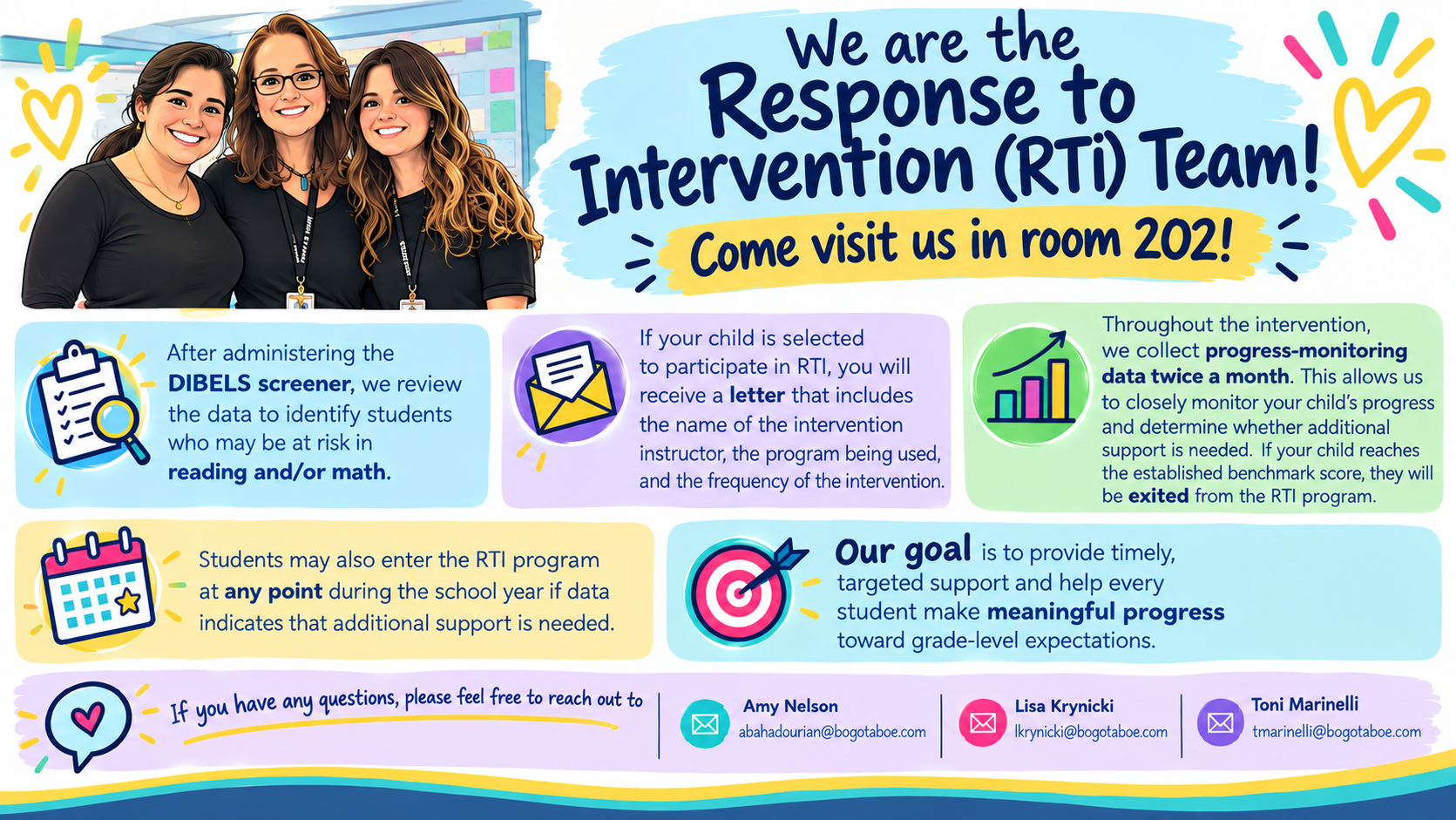
As RTI (Response to Intervention) Instructors, our role is to provide students with targeted, research-informed instruction based on their individual academic needs. We work closely with students who need additional support in reading and mathematics, using assessment data to identify specific skill gaps, provide focused intervention, monitor progress, and adjust instruction as students grow.
Our goal is not simply to give students more instruction—it is to provide them with the right instruction, at the right level, using effective strategies and programs that address the skills they need most.
📚 Reading Intervention: Reading Simplified
For reading intervention, we use Reading Simplified, a streamlined, evidence-based approach designed to help beginning and struggling readers develop the skills necessary for accurate, automatic word reading and fluency. Reading Simplified focuses on the essential components of decoding rather than overwhelming students with isolated skills.
The program emphasizes skills such as:
Phonemic awareness
Letter-sound relationships
Blending and segmenting
Phonics and word analysis
Decoding
Multisyllabic word reading
Word-reading automaticity and fluency
Activities such as Switch It, Read It, Sort It, and Write It allow students to work with multiple reading skills at the same time. The approach is designed to move students from learning individual sounds and patterns toward efficiently decoding words and ultimately reading connected text with greater accuracy and fluency.
Rather than simply asking students to memorize words, we help them understand how our written language works and how to use that knowledge to read unfamiliar words.
➕ Mathematics Intervention - Whole Number Foundations, Jump Math, Pirate Math Equation Quest
For math intervention, we use several programs and approaches, including Whole Number Foundations, JUMP Math, and Pirate Math Equation Quest.
These programs allow us to address both foundational mathematical understanding and problem-solving skills. My instruction focuses on identifying what students understand, finding the gaps that are preventing them from moving forward, and systematically building those skills.
Whole-Number Foundations uses a structured approach to help students understand is concepts such as number sense, place value, operations, and relationships between numbers provide the foundation for later mathematical learning. Research on foundational math interventions similarly emphasizes number sense, base-ten concepts, place value, operations, and related properties as critical early areas of development.
JUMP Math uses a structured, scaffolded approach in which students develop mathematical understanding through carefully sequenced lessons and gradually more challenging concepts. The program emphasizes understanding mathematics rather than simply memorizing procedures.
Pirate Math Equation Quest helps students develop strategies for solving mathematical word problems by teaching them to identify the important information in a problem, determine what is being asked, and represent the problem with an equation.
🔢 Why Math Fact Fluency Matters
A major part of my math intervention is developing math fact fluency.
Math fact fluency is more than simply being able to memorize answers. Students need to develop the ability to retrieve basic facts accurately, efficiently, and with increasing automaticity. When basic facts become easier to access, students have more mental capacity available for the mathematics that comes next—such as multi-step computation, problem solving, fractions, place value, and algebraic thinking.
For example, if a student has to use a great deal of mental effort to figure out 7 + 8, that effort can compete with the mental resources needed to solve a larger problem. Building fluency helps make those basic relationships more automatic so students can devote their attention to understanding and solving more complex mathematics.
We therefore work on fact fluency while also building number sense and conceptual understanding. Students learn strategies and relationships between numbers rather than relying exclusively on rote memorization.
🎯 The Goal of RTI
Ultimately, our goal as an RTI team is to help students become more confident, independent, and successful learners.
We use assessment data to determine where a student is starting, provide targeted intervention, monitor progress, and continually adjust instruction. Whether we are helping a student learn to decode an unfamiliar word, build understanding of whole numbers, develop math fact fluency, or solve a word problem, we want students to leave intervention with skills they can apply independently—not just answers they can produce during an intervention session.
RTI is about finding what a student needs, providing purposeful instruction, monitoring whether it is working, and responding to the data. Our role is to make that instruction targeted, meaningful, and effective for each student.
More Information